For thousands of years, people have turned to art for self-expression, healing, and connection. Today, science helps us understand why — creativity doesn’t just inspire us, it transforms the brain.
A Timeless Practice
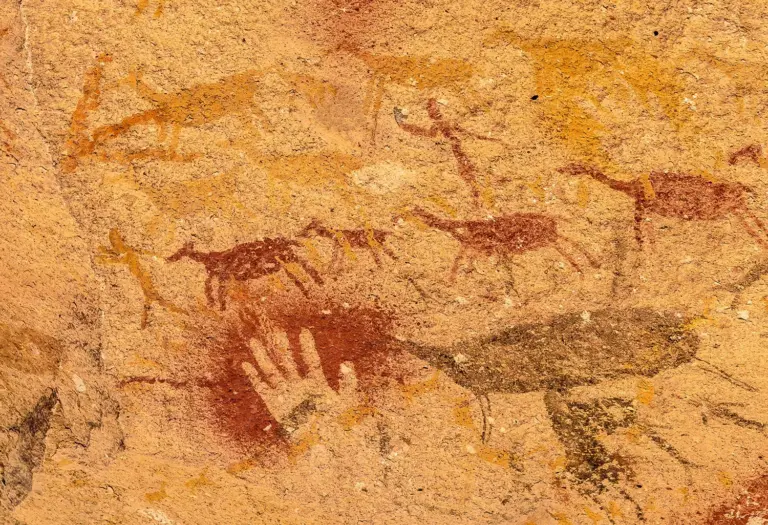
Across cultures and centuries, humans have relied on the arts to communicate, release emotion, and find meaning. Long before written language, art was how we told stories, shared experiences, and connected to something larger than ourselves.
Source: “Art Making and Expressive Art Therapy in Adult Health and Nursing Care: A Scoping Review” — nlm.nih.gov
Creativity and the Brain
“Anything that engages your creative mind — the ability to make connections between unrelated things and imagine new ways to communicate — is good for you.”
— Girija Kaimal, Professor & Researcher, Drexel University
Art’s ability to flex our imaginations may be one of the reasons why we’ve been making art since we were cave-dwellers, says Kaimal. It might serve an evolutionary purpose. She has a theory that art-making helps us navigate problems that might arise in the future. She wrote about this in October in the Journal of the American Art Therapy Association.
It activates the reward center of our brain
For a lot of people, making art can be nerve-wracking. What are you going to make? What kind of materials should you use? What if you can’t execute it? What if it … sucks?
Studies show that despite those fears, “engaging in any sort of visual expression results in the reward pathway in the brain being activated,” says Kaimal. “Which means that you feel good and it’s perceived as a pleasurable experience.”
THE FLOW STATE
“When you’re in the zone — fully absorbed in making something — you lose all sense of time and space.” — Girija Kaimal
Ultimately, says Kaimal, making art should induce what the scientific community calls “flow” — the wonderful thing that happens when you’re in the zone. “It’s that sense of losing yourself, losing all awareness. You’re so in the moment and fully present that you forget all sense of time and space,” she says. And what’s happening in your brain when you’re in flow state? “It activates several networks including relaxed reflective state, focused attention to task and sense of pleasure,” she says.